
Every publisher gets the same advice about floor prices, and it is useless in both directions. Raise them and you will earn more per impression. Raise them too far and you will not sell anything. Great. What number do I type in the box?
Nobody can give you that number, because it depends on your audience, your placements, your geography and which buyers happen to want them this quarter. What can be given is a way of thinking that stops you either leaving money on the table or blowing up your fill rate to find out where the edge is.
What a floor actually does
A floor price is an instruction attached to every bid request: do not bother replying below this number.
That is all it is. It does not raise what buyers are willing to pay. It removes the ones who would have paid less, in the hope that someone above the line takes the impression instead.
So a floor is a bet. You are wagering some fill rate against a higher price on what remains. Whether the bet pays depends entirely on how much genuine demand sits above your line, which is a fact about your inventory that you can only find by testing.
The shape of the curve
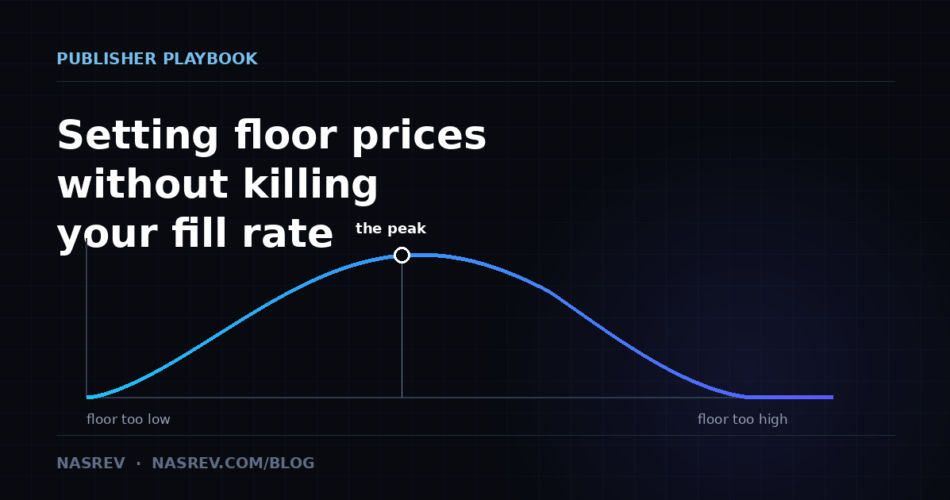
Plot revenue against floor price and you get a hill, not a slope.
Start at zero and you sell everything at whatever the cheapest bidder offers. Total revenue is mediocre because your price is terrible. Raise the floor and revenue climbs, because you are still selling most of your inventory but at better prices. Keep going and you hit a peak. Past the peak, revenue falls off a cliff, because the volume you are losing is worth more than the price improvement on what remains.
Almost every publisher I have looked at sits to the left of their peak. The instinct is to protect fill rate, so floors get set low and left alone, and years of small price improvements never happen.
The cliff on the right-hand side is genuinely steep, though. Which is why you test rather than guess.
Why one floor for everything is the real problem
Before touching the number, look at how many numbers you have.
A single site-wide floor treats your best placement and your worst placement identically. Your above-the-fold leaderboard on your highest-value article and the third unit down a category page are not worth the same to a buyer, and pricing them the same guarantees one is underpriced and the other unsold.
Segment before you optimise. In rough order of how much difference it makes:
- By placement. Above the fold, in-content, sidebar, footer. The single biggest source of price variation on most sites.
- By geography. A US or UK impression and one from a market where you have almost no demand are different products. One floor for both means one of them is wrong.
- By device. Mobile and desktop clear at different prices and often through different buyers.
- By format. Video and display should never share a floor.
Four placement floors set roughly right will beat one site-wide floor optimised to three decimal places.
A test that will not cost you a month
Here is a routine that gives you an answer in about three weeks without risking much.
Establish a baseline. Two clean weeks of data. Record revenue, fill rate, CPM and impressions per placement. If you skip this you will have nothing to compare against and you will end up arguing with yourself about whether things improved.
Pick one placement. Not the whole site. Choose a placement with meaningful volume, so the results mean something, but not your single biggest earner, so a mistake is survivable.
Raise it by about 15%. Small enough to be safe, large enough to move the numbers out of noise. Leave it for a full week. Traffic has weekly rhythms and a three-day test tells you about Wednesday.
Read total revenue, not CPM. This is where most tests go wrong. CPM will almost always rise when you raise a floor, because you removed the cheap bids. That is arithmetic, not success. The number that matters is total revenue for the placement. If CPM is up 20% and revenue is down 5%, you overshot.
Then decide. Revenue up, raise again by 15% and repeat. Revenue down, go back and try a smaller increase. Revenue flat, you are near your peak and it is time to work on a different placement.
Two or three cycles usually finds the top of the hill. Then leave it, and revisit quarterly, because demand shifts and a floor set last February is a guess about a market that has moved.
Where floors go wrong
Setting them and forgetting them. The most common failure by a distance. A floor is a live setting, not a configuration you complete.
Copying someone else’s numbers. Floor prices from a forum post are about someone else’s audience and someone else’s demand. Directionally interesting, operationally worthless.
Raising floors to fix a demand problem. If your revenue is falling because a buyer paused a campaign, a higher floor makes it worse. Diagnose first. Floors fix underpricing, not undersupply.
Testing during an unusual period. Do not run a floor test through Black Friday, a holiday week, or a traffic spike from one viral article. You will measure the event, not the floor.
Forgetting that some partners override you. Not every integration honours a floor the way you set it. Some apply their own logic on top. Worth asking each of your partners directly, and worth noticing which ones answer clearly.
The question underneath all of this
Floor prices are the one lever you control without asking anyone’s permission. Everything else in your monetisation stack involves a partner, an integration, or a negotiation. The floor is yours.
Which is why it is worth the twenty minutes a month it takes to do properly. Most publishers spend more time than that chasing a partner over a discrepancy worth less than the revenue sitting in an untested floor.