
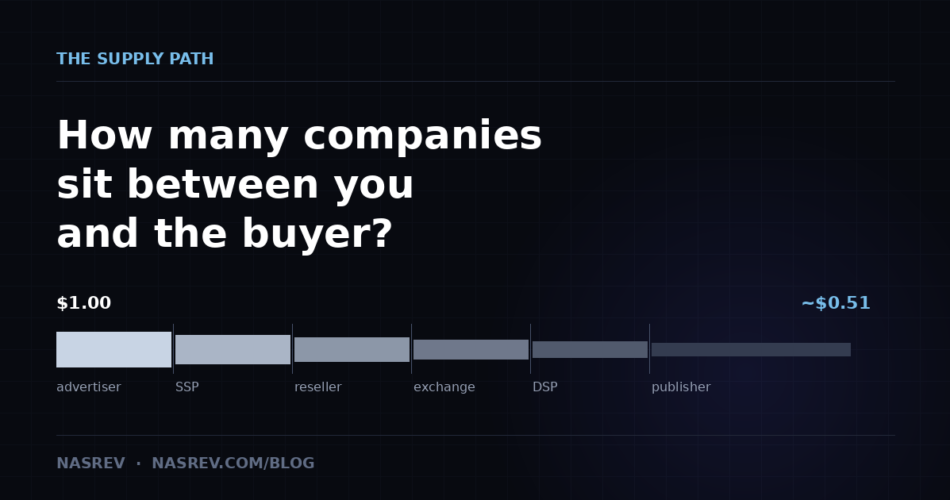
In 2020, ISBA and the Association of Online Publishers asked PwC to do something that sounds simple. Take money that advertisers spent, follow it through the programmatic supply chain, and confirm it arrived at the publishers.
The auditors found that publishers received about half of advertiser spend, and that 15% of it could not be attributed at all. Not lost to fees anybody could name. Simply unaccounted for. The industry called it the unknown delta, which is a wonderfully bloodless phrase for “we followed the money and it went somewhere we cannot identify.”
A follow-up study in 2022 was better news. The unattributable spend fell to 3%, and the impression match rate between DSPs and SSPs rose from 12% to 58%. Real improvement, driven by advertisers demanding audits and the industry building tools to support them.
But read that match rate again. In 2020, auditors could match one impression in eight between the system that bought it and the system that sold it. Not fees. Not margin. Basic identification of whether the thing bought was the thing sold.
Why the chain got long
Nobody designed this. It accumulated.
A publisher integrates an SSP. The SSP wants more demand, so it connects to other exchanges. Those exchanges have their own supply partners, some of whom are reselling inventory they got from somewhere else. A DSP buys through several of them at once, which means the same impression can reach the same buyer four times through four different paths, at four different prices.
Each link was rational for the company that added it. Collectively they produced a system where an impression is bought and sold repeatedly on its way to being shown once, and where every participant takes a percentage for the privilege of passing it along.
The technical term is supply path. The practical meaning is how many companies handle your money.
What a long path actually costs you
It is not only fees, though fees are the obvious part.
Latency. Every hop adds milliseconds. Requests that arrive after the timeout are worth nothing, whatever the bid.
Bid duplication. When your inventory reaches a DSP through five paths, the DSP does not bid five times as enthusiastically. It often bids less carefully, or throttles you entirely, because scoring the same impression repeatedly costs it money in infrastructure.
Loss of information. Detail degrades at every hop. By the time a buyer sees your impression it may not accurately reflect the placement, the position or the domain. Buyers price uncertainty as risk.
Loss of accountability. When something goes wrong, and something always eventually goes wrong, a five-party chain means five companies who can each point at the others.
Measuring your own path
You do not need an audit to get a rough picture. Three things you can check this week.
Read your own sellers.json entries
Every exchange publishes a sellers.json file listing who it sells on behalf of. Find yourself in the file of each partner you work with. Two things to look at.
Is your relationship marked DIRECT or INTERMEDIARY? Direct means they have a relationship with you. Intermediary means they got your inventory from someone else, which means there is at least one more company in the chain than you thought.
Is the entry marked confidential? Some legitimately are. But a partner whose entire seller list is confidential is a partner whose buyers cannot verify what they are buying, and that shows up in what they will pay.
Audit your ads.txt properly
Most ads.txt files are archaeology. Lines get added when a partner asks and almost never removed when the relationship ends.
Go through yours line by line and ask, for each entry, whether you are actively working with that company today. Every stale line is a company still authorised to sell your inventory. Every RESELLER line is an explicit statement that somebody is allowed to sell your inventory onward.
Cutting a bloated ads.txt file down to the partners you actually use is unglamorous work that frequently improves what buyers will pay, because it makes your supply legible.
Ask the awkward questions
The best diagnostic is a direct question to each partner, and the quality of the answer tells you as much as its content.
- What is your take rate on my inventory, as a percentage, in writing?
- Is that rate fixed, or does it vary by transaction?
- Do you resell my inventory to other exchanges? If so, which?
- How long is the schain on a typical bid request from my site?
- Do you run any auction before or after the one I can see?
- Can I get a domain-level report showing which buyers actually purchased?
A partner who answers all six clearly is worth keeping regardless of their rate. One who takes three weeks and produces a paragraph about proprietary methodology has told you something useful too.
What changed, and what did not
Supply path optimisation became a real discipline after 2020, mostly on the buy side. Large agencies now actively reduce the number of paths they buy through, and buying directly from fewer, cleaner sources is now normal practice rather than an experiment.
That gives publishers leverage they did not previously have. If buyers prefer short, verifiable paths, then having one is a commercial advantage rather than an act of principle.
What has not changed is that the information asymmetry still runs one way. Most publishers still cannot state, with confidence, what percentage of an advertiser’s dollar reaches them. That number exists. It is just held by other people.
You will not fix the whole supply chain. You can find out how long yours is, cut the links that are not earning their place, and start asking every partner the six questions above.
Anyone who will not answer them has answered them.